President Abdel Fattah Al-Sisi told some 70 international business leaders on Wednesday that the Egyptian economy has successfully absorbed major global shocks and is prioritising private sector expansion through wide-ranging incentives and structural reforms.
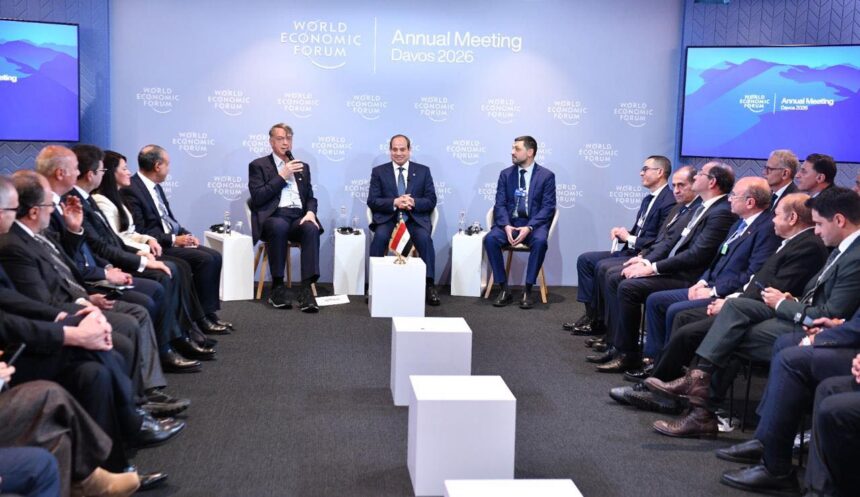
Speaking at a dialogue session on the sidelines of the World Economic Forum (WEF), Al-Sisi invited investors to capitalise on opportunities within the Egyptian market, citing the country’s logistical capabilities and a legislative environment designed to facilitate business. The President emphasised that Egypt’s stability is fundamentally rooted in the”awareness and understanding of the Egyptian people,” which has allowed the nation to navigate the challenges posed by the COVID-19 pandemic and the conflicts in Ukraine and Gaza.
Presidency spokesperson Mohamed El-Shennawy said the session, moderated by WEF Interim Co-Chair André Hoffmann and Managing Director Maroun Kairouz, included chief executives from the energy, digital transformation, transport, and financial sectors. Hoffmann stated that the meeting reflected Egypt’s international standing and aimed to showcase Sisi’s vision for private sector involvement in the state’s comprehensive development plans.
Sisi outlined a strategy focused on expanding the private sector’s role, including the implementation of the State Ownership Policy document and an initial public offering (IPO) programme. These measures, along with a ceiling on public investment, have led to an increase in the private sector’s share of total investment in Egypt, El-Shennawy said.
The President highlighted specific incentives in priority sectors, such as the “Golden License” programme, the Green Hydrogen Incentives Law, and tax reforms managed through a unified digital platform. These initiatives target industries including electric vehicle manufacturing, information technology, and renewable energy.
Regarding macroeconomic performance, Al-Sisi noted that Egypt’s economic programme, conducted in cooperation with international financial institutions led by the International Monetary Fund (IMF), has resulted in improved indicators. These include higher credit ratings, increased growth rates, an improved balance of payments, and a rise in foreign reserves, alongside a decline in the debt-to-GDP ratio.
In a separate meeting, Al-Sisi held talks with WEF President and Chief Executive Børge Brende to discuss global challenges and development. Brende expressed appreciation for Egypt’s participation and noted that the forum had dedicated a special session to Egypt to review its vision for Middle East challenges and regional security.
Brende praised Al-Sisi’s personal efforts to consolidate regional stability and expressed a desire to continue coordination with the Egyptian government to boost economic growth and attract further investment.
The Presidency spokesperson added that the dialogue with business leaders also touched upon the modernisation of Egypt’s infrastructure. Sisi pointed to the development of road networks, ports, and the Suez Canal Economic Zone. He noted that shipping companies are gradually returning to the Suez Canal following the Sharm el-Sheikh Peace Summit, reinforcing the waterway’s role as a pivotal corridor for international trade.
Sisi also discussed the Egypt Industry 2030 strategy, which seeks to increase the industrial sector’s contribution to GDP, and ongoing efforts to achieve universal health coverage by upgrading medical infrastructure and technology in partnership with the private sector.