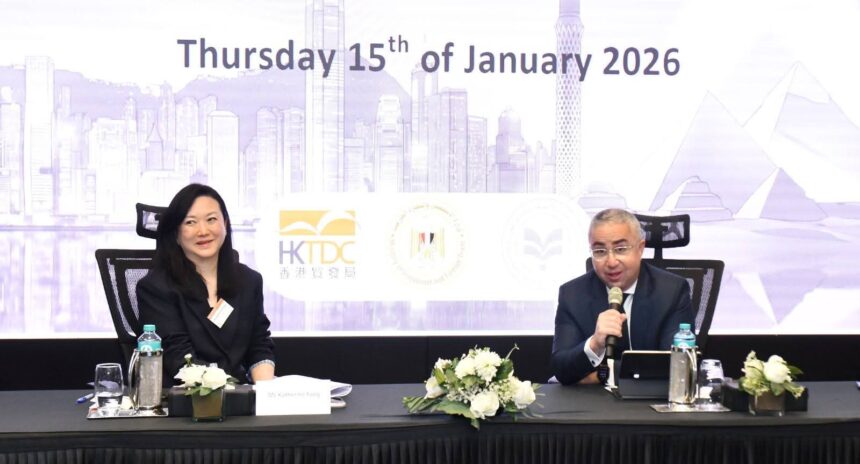
Egypt’s General Authority for Investment and Free Zones (GAFI) held a roundtable meeting with the Hong Kong Trade Development Council (HKTDC) to explore opportunities for strengthening investment partnerships in the textile and ready-made garments sector.
The meeting was chaired by Mohamed El-Gousky, Chief Executive Officer of GAFI, and attended by Katherine Fang Suk Kwan, Chairwoman of HKTDC’s Garment Advisory Committee, alongside representatives of Egypt’s Apparel Export Council (AEC), a number of Egyptian companies, and leading textile and garment manufacturers from both sides.
El-Gousky said Egypt’s textile and garment sector is among the country’s most competitive industries, supported by a well-established industrial base, accumulated expertise, a highly skilled workforce, and the availability of production inputs and qualified industrial infrastructure.
He noted that these strengths position Egypt as an ideal hub for industrial expansion, the localisation of value-added supply chains, and deeper integration with regional and international markets.
El-Gousky also highlighted the strategic importance of the partnership between Egypt and Hong Kong, describing it as a key driver in reshaping global value chains in the textile industry. He added that Hong Kong serves as a gateway for Chinese and Asian companies seeking overseas expansion, as well as one of the world’s leading financial centres capable of mobilising investment financing.
In this context, he said Egypt represents a strategic gateway to African markets, offering investors access to a vast consumer base and preferential trade arrangements.
El-Gousky further noted that GAFI is working to deepen cooperation with Hong Kong by fostering an open and continuous dialogue platform between the business communities of both sides and by providing a highly attractive and supportive investment environment. He also pointed out that the Egyptian government has established a dedicated unit to attract Chinese investments, offering fast-track services and ongoing support to address investors’ needs and challenges.
For her part, Katherine Fang Suk Kwan said Hong Kong’s economic institutions do not view Egypt merely as a manufacturing base or an attractive investment destination, but as a strategic partner essential to the future of China’s textile and garment industry.
She highlighted Egypt’s progress in developing production chains, strengthening trade relations, and improving compliance with sustainability standards, in addition to its competitive advantages in geographic location, skilled labour, and advanced infrastructure.
Meanwhile, Iris Wong, Director of External Relations at HKTDC, invited Egyptian companies to participate in the Council’s exhibitions and trade events, noting that HKTDC organises around 40 specialised events in the textile and garment sector. These platforms, she said, offer valuable opportunities for Egyptian companies to exchange expertise, establish partnerships, and access new markets, particularly as Egypt is a cornerstone of China’s Belt and Road Initiative.
Sherine Hosny, Executive Director of the Egyptian Export Council for Ready-Made Garments, said Egypt is a natural destination for the expansion of Chinese companies, citing its competitive advantages, including labour availability, developed utilities, streamlined procedures, and preferential trade agreements with major global markets.
She revealed that Egyptian garment exports to the European Union and the United States increased by 97% and 46%, respectively, over the past five years.
The meeting also featured promotional presentations highlighting investment opportunities in Egypt and the range of investment frameworks available to meet investors’ needs, in addition to bilateral meetings between companies from both sides interested in establishing investment partnerships.