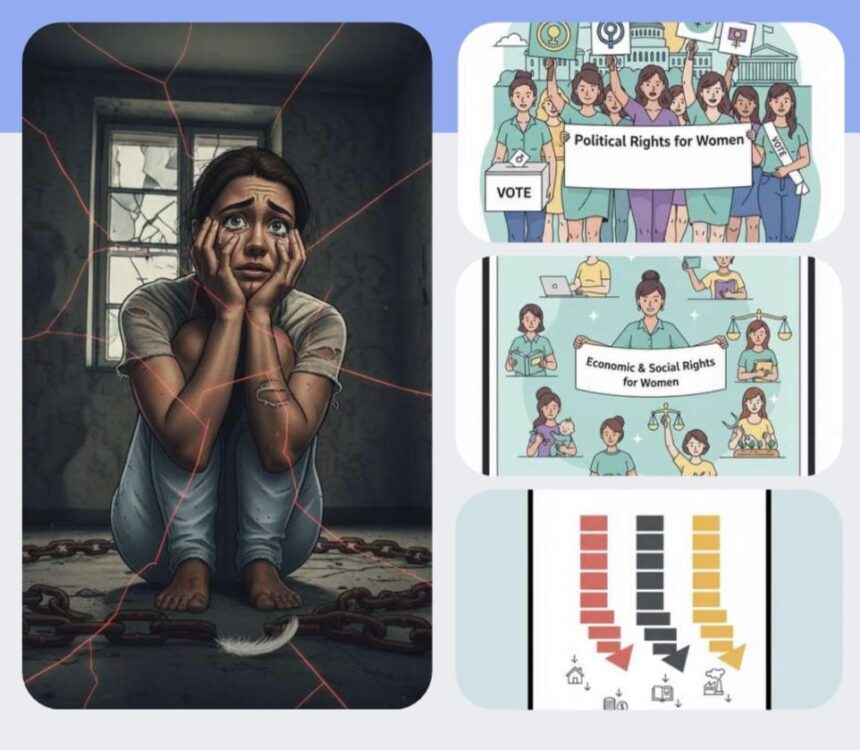
The year 2025 has concluded, presenting a complex landscape for women’s rights in Egypt. According to the newly released annual report by the Egyptian Centre for Women’s Rights (ECWR), titled “Egyptian Women 2025: Rights Gaps and the Shadows of Violence,” the country continues to navigate a gap between its legislative frameworks and the practical experiences of its female citizens. While institutional structures remain active, the report identifies the year as a period of significant challenges, marked by persistent social barriers and safety concerns that impact the pursuit of full equality.
Safety and Public Space: Navigating Social Dynamics
A primary focus of the ECWR’s 2025 report is the ongoing prevalence of violence against women. The report observes that these incidents occur across both private and public spheres. Within the home, cases of domestic violence—sometimes resulting in fatalities—are often categorised under the umbrella of “family disputes,” a trend the report suggests requires more robust legal intervention. The documentation of violence affecting women early in marriage highlights a specific area of vulnerability that warrants further social study.
The report also addresses safety in public spaces, noting that harassment remains a significant hurdle for women’s freedom of movement. One specific instance cited involved a physical and verbal altercation on the Cairo Metro, where a young woman was confronted by a passenger regarding her public conduct. The ECWR characterises such incidents as part of a broader social pressure that can discourage women’s full participation in public life.
Political Representation and the Quota System
In the political arena, the 2025 elections for the House of Representatives and the Senate provided a clear look at the current state of female representation. Despite constitutional guarantees and mandated quotas, the report finds that women continue to face significant obstacles when running for individual seats outside of protected lists.
In the Senate elections, female representation was achieved exclusively through the closed-list system, with no women securing individual seats. The report suggests this is due to long-standing social norms and the difficulty of breaking into established political networks. The House elections followed a similar trend: of the 173 women contesting individual seats, only three were successful. Consequently, the majority of women in parliament entered via party lists—a process the report notes can sometimes be viewed as a procedural necessity rather than a reflection of competitive electoral gains.
The ECWR also evaluated the role of political parties, noting that many limited female participation to the minimum legal requirements. This has led to questions regarding whether the inclusion of women is being driven by a commitment to leadership diversity or simply by technical compliance with the law.

Economic Participation and Structural Barriers
Economically, the data suggest that Egyptian women remain underutilised in the workforce. Citing figures from the Central Agency for Public Mobilisation and Statistics (CAPMAS), the report identifies a significant gender gap. While male labour force participation is at 70.3%, female participation stands at 16.9%. Furthermore, the female unemployment rate reached 17.1%, compared to a male rate of 4.2%.
The report posits that this economic disparity, coupled with social and political challenges, continues to affect Egypt’s performance in global development and gender parity metrics.
International Benchmarks and Comparative Rankings
The ECWR report includes an analysis of Egypt’s standing in various international indices. In the Global Gender Gap Report 2025, Egypt ranks 139th out of 148 countries. The sector-specific data shows the country at 145th in economic participation, 111th in health and wellbeing, 101st in political empowerment, and 78th in educational attainment—the latter being the country’s strongest area of performance.
Compared to 2024, Egypt’s overall ranking shifted from 135th to 139th, a move the ECWR identifies as a call for renewed focus on gender-centric policy reforms.
Human Development and the Impact of Inequality
The report also references the 2025 Human Development Report, which maintains Egypt’s classification as a country with “high human development,” with a score of 0.754 and a global rank of 100 out of 193. However, the ECWR notes that when adjusted for inequality, the country’s development value decreases by approximately 22.8%.
This is further reflected in the Gender Inequality Index (GII), where Egypt scores 0.398, ranking 101st globally. These figures highlight the ongoing need to address disparities in labour market access and reproductive health to ensure more balanced national growth.
Indicators of the Rule of Law
One of the report’s final sections examines Egypt’s performance in the 2025 Rule of Law Index. While Egypt possesses an established judicial history, its global ranking currently stands at 135th out of 143 countries.
The report notes low rankings in categories such as fundamental rights (141st) and constraints on government powers (141st). While the country performs relatively well in the “order and security” category, the ECWR emphasises that physical security is most effective when paired with advancements in civil rights and institutional accountability.
The Road Ahead
Ultimately, the ECWR report serves as an analytical look at the work remaining to be done. It suggests that the distribution of opportunities is inextricably linked to the strength of legal and institutional frameworks. While Egypt maintains stability and security, the report concludes that for women to achieve the full promise of citizenship, there must be a shift from symbolic representation toward substantive inclusion in all sectors of the public sphere.