

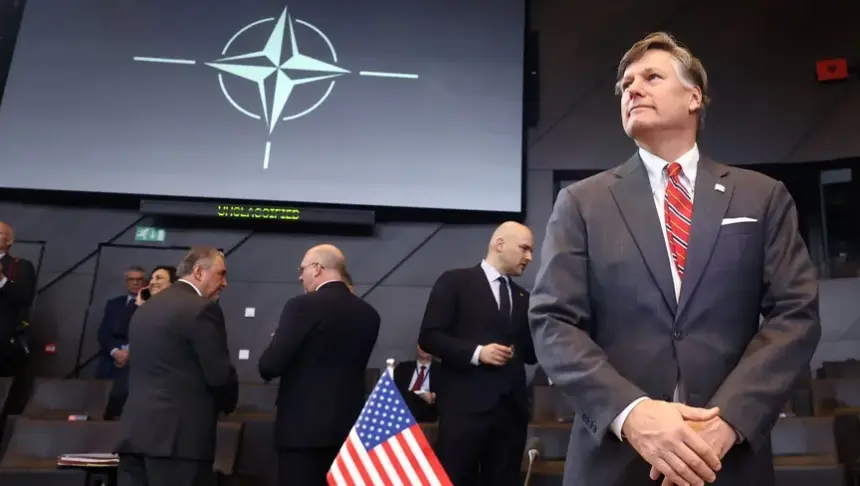
US Deputy Secretary of State Christopher Landau has criticised European NATO allies for prioritising domestic defence companies over American suppliers, warning partners against “bullying” US firms or excluding them from the continent’s rearmament efforts.
According to diplomatic sources cited by Politico, Landau delivered the admonition during a closed-door meeting of NATO foreign ministers on Wednesday, urging allies to ensure American contractors are not shut out of the market as Europe moves to bolster its military industry.
The intervention comes amid heightened transatlantic tensions over trade and defence spending, with Washington increasingly wary of European Union initiatives designed to foster “sovereign” military capabilities.
A US State Department official confirmed the substance of Landau’s message, stating he conveyed two primary points: the need for Europe to convert defence spending pledges into tangible capabilities, and a warning that “protectionist and exclusionary policies that shut out US companies undermine our collective defence”.
The meeting marked the first time in over two decades that a US Secretary of State has missed a NATO ministerial gathering, with Marco Rubio absent from the talks.
Transatlantic Trade Tensions
Landau’s comments reflect a broader strategy by the current US administration to pressure historic partners on trade terms. President Donald Trump has frequently criticised the EU for “unfair” treatment of the United States, while the bloc has previously described Washington’s trade demands as tantamount to “blackmail”.
The dispute over defence procurement arises as NATO allies have pledged to spend 5 per cent of GDP on defence by 2035. Concurrently, the EU is allocating €150bn in defence grants for joint procurement, implementing strict controls that encourage intra-European purchasing and reduce reliance on third countries.
Despite the friction, NATO Secretary General Mark Rutte noted on Wednesday that allies, including Canada and European nations, have pledged $4bn to a NATO-backed plan funding US defence firms to supply Ukraine.
US Dominance and Market Share
American defence contractors are seeking to secure their position in the European market, which accounts for approximately 11 per cent of annual revenue for major players such as Lockheed Martin and RTX.
According to the Stockholm International Peace Research Institute (SIPRI), US firms have strengthened their global foothold, capturing 43 per cent of arms exports over the past five years, up from 35 per cent in the previous period.
In Europe, reliance on American hardware remains high. SIPRI data indicates that arms imports by European NATO members more than doubled between the 2015–2019 and 2020–2024 periods. The US supplied 64 per cent of these weapons, a significant increase from 52 per cent previously.
Thirteen European nations, including Britain, Germany, and Italy, have procured or ordered US-made F-35 fighter jets. European armies have also bolstered stocks of RTX’s Patriot air defence systems and HIMARS rocket launchers.
To maintain market access, US firms are deepening ties with European counterparts. Lockheed Martin is establishing missile production lines with Germany’s Rheinmetall, while a joint venture between Raytheon and European missile maker MBDA will produce Patriot missiles in Germany.
European Industry Growth
Europe’s domestic defence sector is also expanding after years of underinvestment. The AeroSpace and Defence Industries Association of Europe (ASD) reported that the sector grew by 13.8 per cent in 2024, generating revenues of €183.4bn ($213bn). Employment in the sector rose by 8.6 per cent to 633,000 jobs.
However, the ASD warned of persistent challenges, including supply chain bottlenecks, shortages of raw materials and electronic components, high energy costs, and labour market constraints.
Micael Johansson, ASD prominent figure and CEO of Saab, told reporters in Brussels on Tuesday that the continent must persist in building its own industrial base.
“We have to ensure that the defence industry continues to support the building of European sovereign capabilities that enhance deterrence and defence,” Johansson said. “That cannot stop just because a ceasefire is reached or negotiations begin.”


