

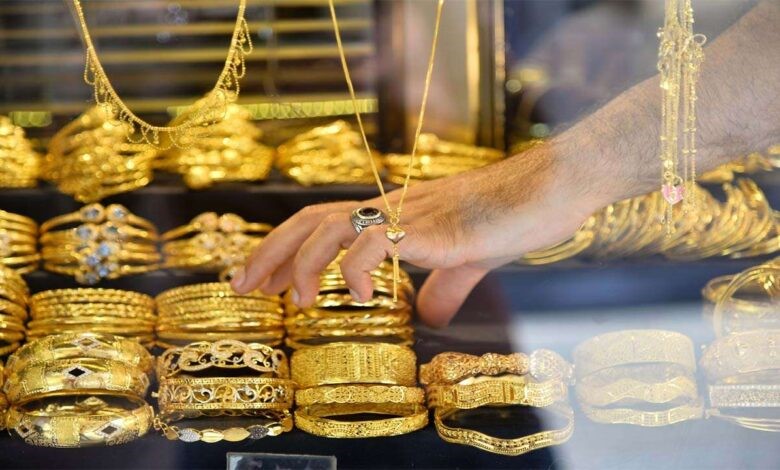
Gold prices posted modest gains in Egypt’s local market during last week’s trading, even as global prices declined sharply amid heightened volatility driven by US dollar strength and escalating geopolitical tensions, according to a report by iSagha.
Saeed Imbabi, Executive Director of the platform, said local gold prices rose by approximately EGP 10. The 21-karat gram opened at EGP 6,915, fell to a weekly low of EGP 6,730, and closed at EGP 6,925. Meanwhile, 24-karat gold recorded around EGP 7,914, 18-karat stood at EGP 5,936, and the gold pound reached approximately EGP 55,400.
Imbabi noted that local prices are trading at a premium of about EGP 292 above global levels when calculated using the Central Bank of Egypt’s exchange rate, reflecting relatively weak domestic demand.
Globally, gold experienced sharp fluctuations throughout the week. The ounce opened at $4,497, dropped to a four-month low of $4,098 early in the week, and later recovered to close at $4,494 on Friday, moving within a wide range between $4,100 and $4,600.
Market dynamics continue to be shaped by multiple factors beyond gold’s traditional safe-haven role. Rising oil prices— with Brent crude surpassing $110 per barrel—are intensifying inflationary pressures, while a stronger US dollar, with its index reaching 100.17, is reducing gold’s attractiveness. At the same time, US Treasury yields remain elevated, with 10-year yields stabilising at 4.438%, increasing the appeal of interest-bearing assets over non-yielding gold.
Federal Reserve officials have highlighted growing uncertainty in monetary policy due to energy market shocks. Anna Paulson, President of the Federal Reserve Bank of Philadelphia, warned of rising fuel and fertiliser costs and their inflationary impact, while Thomas Barkin, President of the Federal Reserve Bank of Richmond, described the oil shock as adding a new layer of “fog” to the policy outlook, favouring a wait-and-see approach on interest rates.
The steepest drop in gold prices occurred last Thursday, when spot prices fell by 2.7% to $4,384.38, pressured by the combined effect of rising oil prices and a stronger dollar.
Despite recent declines, Commerzbank raised its year-end gold forecast to $5,000 per ounce from $4,900, suggesting that the current correction may be temporary.
Lower prices have supported a modest rebound in physical demand. In India, dealer discounts narrowed to $61 per ounce from $75 a week earlier, while in China, premiums eased to a range of $14–$18.
However, the recovery remains fragile. Continued strength in the dollar and elevated oil prices could reinforce expectations that interest rate cuts will be delayed, adding further pressure on gold.
Markets are now closely watching upcoming US labour market data, scheduled for 3 April. Reuters forecasts indicate job gains of around 55,000, with the unemployment rate expected to hold at 4.4%. These figures will play a key role in shaping expectations for US monetary policy and, by extension, gold price trends.
According to CME Group’s FedWatch tool, markets are increasingly pricing in a prolonged period of tight monetary policy, with even a 35% probability of a rate hike by the end of the year.
Additional data from the University of Michigan showed a decline in US consumer confidence in March, alongside rising short-term inflation expectations, further reinforcing the likelihood of sustained monetary tightening.
On the central bank front, Turkey’s central bank has reportedly liquidated around 60 tonnes of gold over the past two weeks—either through direct sales or swap operations—to secure approximately $8bn in liquidity. This reduced its reserves to about 772 tonnes, the lowest level in 13 months.
While analysts suggest these moves are largely liquidity-driven rather than a structural exit from gold, similar actions by other central banks could weigh on prices.
Gold briefly rebounded toward $4,500 per ounce, supported by escalating tensions in the Middle East, including Israeli strikes on Beirut and Iranian missile activity targeting Saudi Arabia, which boosted safe-haven demand.
Nevertheless, broader market sell-offs have pushed gold down by roughly 15% in the current month and 16% since late February, largely due to the strength of the US dollar.
Despite these pressures, opportunistic buying has begun to re-emerge at lower price levels, supporting gold’s longer-term upward trajectory.
At the same time, major Asian financial hubs such as Hong Kong and Singapore are expanding their gold market infrastructure through enhanced clearing systems and storage capacity, reinforcing gold’s role as a strategic reserve asset amid ongoing global uncertainty.
Looking ahead, investors remain focused on key US economic indicators, including employment data, consumer sentiment, and retail sales, which will be critical in determining the direction of monetary policy and the outlook for gold prices in the near term.

