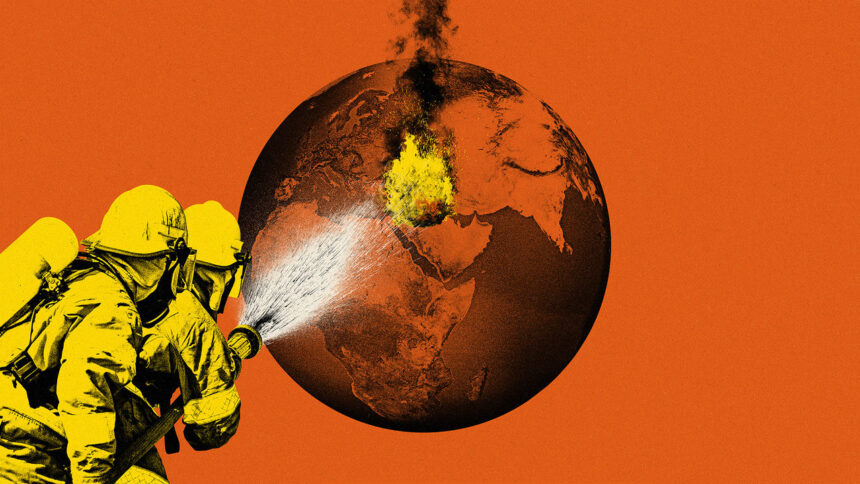
As the picture in the Middle East becomes clearer following the U.S. strike on Iran and Iran’s immediate, measured response, it is worth discussing the concept of “constructive chaos” and its political history. This concept provides a framework for analysing the shock tactics employed by the U.S. and helps interpret the American escalation against Iran and the subsequent calculated Iranian response within a complex regional and international context, where U.S. and Israeli interests intersect. These events cannot be separated from domestic American considerations, including efforts to divert attention from the resurfacing Jeffrey Epstein case. They also keep the Middle East dependent on the American umbrella, shift attention away from the Palestinian issue, and reinforce Israeli strategic superiority—without denying the real dangers associated with nuclear proliferation and without ignoring the missteps and internal miscalculations of Arab states.
The term “constructive chaos” first emerged in U.S. political discourse in the early 2000s. It was based on the notion that certain regions cannot be rebuilt or integrated into a stable international system without first disrupting their traditional structures and breaking old patterns of balance. The idea is not, in itself, a call for chaos as a goal, but rather views it as a “necessary” transitional phase for producing a new order more aligned with the strategic interests of a great power. Practically, this means that instability is not always seen as a policy failure but sometimes as a tool to reshape reality.
This concept gained prominence after the September 11 attacks and was entrenched in political rhetoric during President George W. Bush’s administration, when restructuring the Middle East was framed as a prerequisite for countering what were then described as sources of threat. The most prominent application of this logic was the 2003 invasion of Iraq under the pretext of weapons of mass destruction. Later, it became clear that such weapons were never found, but the strategic outcome was undeniable: the removal of a central, strong state opened the door for a redistribution of influence within Iraq and its surroundings. The resulting fragmentation was not merely a side effect—it became a new regional reality that altered the balance of power in the Arab Mashreq.
The Arab Spring followed, initially driven by legitimate demands for freedom and justice, but in some countries it devolved into armed conflict and institutional collapse. While internal factors were primary, these crises interacted with external interventions and regional polarization. It is important to emphasize that blaming external forces alone would be a gross oversimplification. Structural weaknesses in several Arab states, the lack of gradual reform mechanisms, and political monopolization all made societies more susceptible to upheaval. Chaos was not only imposed externally; it encountered an environment ready to receive it.
Within this broader framework, the recent U.S. strike on Iran can be understood. On the surface, the justification was clear: preventing Tehran from approaching the nuclear threshold. Here, objectivity is necessary. Nuclear proliferation in an already volatile region would heighten the risk of a dangerous arms race. Iran possessing military nuclear capabilities—if it occurs—would be more than symbolic; it would constitute a profound strategic shift affecting Gulf security, Israeli security, and regional deterrence calculations. The concern over an Iranian nuclear capability is therefore not entirely propagandistic but reflects genuine anxiety among several actors.
Yet acknowledging the nuclear threat does not imply acceptance of any particular remedy, nor does it ignore the wider political context. The strike did not occur in a domestic vacuum. It came at a moment when the Jeffrey Epstein case resurfaced in the media, bringing embarrassment to influential circles of wealth and politics. In such an atmosphere, external escalation is a classic tool for reprioritizing public attention: the discussion moves from an elite moral scandal to a national security threat demanding public support for leadership. This does not reduce military decision-making to a single factor, but it highlights the intersection of domestic and foreign calculations.

At the same time, the escalation reinforced the image of a Middle East on the brink, enhancing the logic of continuous American presence as a stabilizing force. The higher the tension, the more Gulf states and others depend on the U.S. security umbrella—through arms deals, defense arrangements, or intelligence coordination. In this sense, the crisis becomes an instrument for consolidating Washington’s role, not merely a transient confrontation.
The Iranian response was measured as well. It was not a full-scale escalation, but rather a demonstration of capability and deterrence without sliding into open war. This pattern of action and reaction produces chronic tension: no major war, yet no stable peace. Here lies one manifestation of contemporary constructive chaos—not through direct occupation, as in Iraq, but through the management of ongoing tensions that keep the region in strategic fluidity.
In this environment, American and Israeli interests converge clearly. For Israel, weakening Iran’s military capabilities—conventional or unconventional—represents a direct strategic gain. Meanwhile, keeping the region preoccupied with the “Iranian threat” diverts attention from the Palestinian issue and reshuffles regional priorities, preventing them from taking centre stage as in previous periods. With continued Israeli military and technological superiority, Israel consolidates its image as the most stable and dominant power in a turbulent neighbourhood, gaining greater political and security manoeuvring space.
However, Arab domestic responsibility cannot be dismissed. The absence of a collective regional security framework, internal rivalries, and the short-term orientation of some policies all facilitate the transformation of the region into a perpetual arena of contention. Had there been a minimum level of Arab strategic coordination, and had priority been given to building strong institutions and productive economies, the ability of external actors to exploit crises would have been greatly reduced, and no regional escalation would have served as a gateway for reshaping the entire scene.
Constructive chaos in its Trumpian version does not necessarily imply a secret, masterfully planned strategy; rather, it reflects a mindset that views crises as opportunities for recalibration and repositioning. A strike on Iran, a limited response, Gulf tensions, energy market jitters, political realignments, and the relative sidelining of other issues—all these episodes incrementally shift the equations: domestic U.S. focus is projected outward, the Middle East becomes more dependent on Washington, Israel strengthens its regional position, while the region remains in perpetual anticipation.
The real challenge for regional states is twofold: to realistically address the nuclear threat while resisting the transformation of its management into a pretext for perpetuating instability or marginalizing core issues, foremost among them Palestine. Internal reform and building trust between state and society are not intellectual luxuries—they are the first line of defense against any project exploiting the fragility of Arab regimes. Between nuclear anxiety and the calculations of great powers, the Middle East’s fate hinges on its ability to reduce its susceptibility to external reshaping whenever internal instability intensifies.
Dr. Marwa El-Shinawy – Academic and writer