

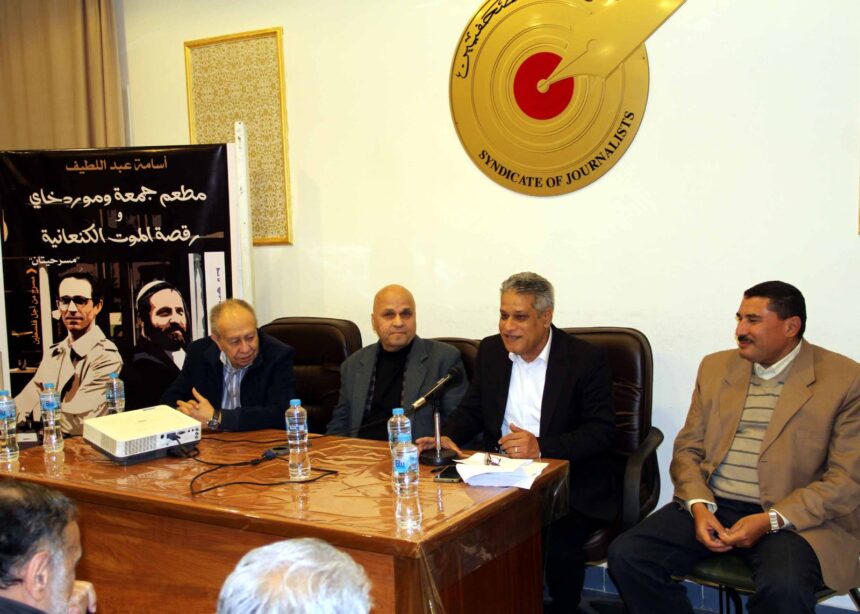
Beneath the storied chandeliers of the Egyptian Journalists’ Syndicate, the air recently hummed with a specific kind of intellectual electricity—the kind that only arises when art collides head-on with the most painful of geopolitical realities. The Cultural and Artistic Committee played host to a symposium that was less of a standard book review and more of a theatrical autopsy. At the centre of the surgical table were two new scripts by journalist and playwright Osama Abdel Latif: Gomaa and Mordechai’s Restaurant and The Canaanite Dance of Death.
The gathering, moderated with poise by Mostafa Khallaf, served as a rallying cry for a “Theater for Palestine.” It brought together a “Who’s Who” of the Egyptian stage—directors, critics, and veterans—to grapple with a singular, haunting question: Can the stage still serve as a weapon of resistance in an era of normalisation and cultural fatigue?
A Parisian Kitchen of Mirrors: The Case of Gomaa and Mordechai
The centrepiece of the evening was Gomaa and Mordechai’s Restaurant, a work that uses the claustrophobic setting of a Parisian kitchen to mirror the existential dread of the Arab-Israeli conflict. The play follows an Egyptian Muslim and a French Jew, partners in a culinary venture, who are locked in a perpetual cycle of suspicion. When a murder occurs—the victim being a character named Isaac—the kitchen transforms into a noir-ish interrogation room. Is it a crime of passion, or a racial hate crime?
Legendary director Essam El-Sayed was visibly moved by the script’s nuance. “Osama possesses a rare gift for finding untrodden paths,” El-Sayed remarked. “He places the two parties in a direct, almost uncomfortable confrontation. By focusing on a ‘Jew’ rather than an ‘Israeli,’ he navigates the vital distinction between faith and Zionism.”
However, El-Sayed, ever the pragmatist of the stage, voiced a sophisticated concern. He noted that while a reader might grasp the nuances of the text, a theatre audience—distracted by the visual and auditory spectacle—might mistake the “partnership” for a call to “normalisation” (Tatbi’).
“In the theatre, the eye and ear are occupied; the intellectual core can sometimes be lost in the performance,” El-Sayed cautioned. “There must be an iron-clad emphasis that this is a struggle of existence and interests, not just a religious spat. As I told my colleagues during my time at the Comedy Theatre, we must avoid any ‘backdoor’ to normalisation. There is no middle ground with an occupier.”
Breaking the Silence: The Post-Camp David “Creative Drought”
Critic Ahmed Abdel Razek Abu El-Ela used the symposium to deliver a scathing indictment of the current state of Egyptian drama. He noted that since the 1990s, the Egyptian stage has largely retreated from the Palestinian cause, a silence he attributed to a “post-Camp David” anxiety.
“Playwrights have begun to fear the censor’s red pen, or perhaps they fear wasting their breath on a public they think no longer cares,” Abu El-Ela observed. He praised Abdel Latif for breaking this drought, comparing his courage to that of the late Saad El-Din Wahba, whose 1992 play Al-Mahrousa 2015 prophetically warned of Zionist encroachment into the Egyptian agricultural sector.
Abu El-Ela argued that creative resistance is the necessary shadow of armed struggle. “The writer does not carry a rifle, but he can turn a dialogue into a bullet. This is exactly what the occupying entity fears most—the immortality of the narrative.”
While he lauded Gomaa and Mordechai for their “tightly woven dramatic structure” and its use of eloquent Classical Arabic (Fusha), he was more critical of The Canaanite Dance of Death. He categorised the latter as a documentary piece that, while historically vital in documenting the irony of Arabs protecting Jews from Nazism only to be met with modern massacres, still lacks the “igniting event” required to transform a political article into a dramatic masterpiece.
Egos and Ideologies: The “Heated” Backstage History
True to the traditions of the Journalists’ Syndicate, the evening was peppered with “heated discussions” that revealed the fractures within the artistic community. A fascinating exchange erupted when Hoda Wasfi, the former doyenne of the National Theatre, addressed the ghost of Saad El-Din Wahba.
The room revisited the controversy of why Wahba’s Al-Mahrousa 2015 was once halted at the National Theatre. While rumours of political censorship by former Minister Farouk Hosni have persisted for years, Wasfi offered a sharp, administrative correction. “It was I who stopped it,” she declared. “Saad was a giant, but he refused to wait his turn in the schedule. I had a production by Essam El-Sayed ready to open. I chose the work over the ego of the writer. One must sometimes say ‘no’ even to the greats.”
This led to a broader, existential clash between journalist Mohie El-Din El-Saeed and playwright Said Haggag. When El-Saeed sceptically asked, “Does theatre even exist anymore?” Hajjaj fired back, “The question isn’t if it exists, but when was the last time you actually bothered to sit in a theatre seat?”
Essam El-Sayed stepped in to bridge the gap, blaming the perceived “death of theatre” on state austerity. “We produce over 4,000 plays a year—more than the rest of the Arab world combined,” he noted. “But we are banned from spending a single pound on advertising. If the public doesn’t know we are there, is it the fault of the artist or the silence of the media?”
A Call to Action for the Next Generation
As the night drew to a close, the floor was opened to a diverse array of voices. Journalist Ashraf Shobak proposed that “Theater for Palestine” should not remain a solo effort by Abdel Latif but should become a collective movement. Meanwhile, Mohamed Zeid, who witnessed the reality on the ground as a radio correspondent in Palestine, urged the author to look toward the future. “We need a third play,” Zeid said. “One that captures the world as it exists after October 7th.”
In his closing response, Osama Abdel Latif displayed the humility of a seasoned creator. He accepted the critiques of his peers—including notes from veterans Sayed Hafez and Mourad Mounir about the need for more dramatic tension and fewer scene changes.
“I wrote The Canaanite Dance of Death in a race against time, driven by a sense of duty,” Abdel Latif admitted. “Our children are losing the memory of the cause. If my writing can act as a document, a piece of ‘dramatic literature’ that stays between the covers of a book when the stage is closed to us, then I have done my part. We cannot allow the memory of the struggle to be erased by the passage of time or the ink of a treaty.”
The symposium ended not with a final curtain, but with a sense of a beginning. In the heart of Cairo, the “Theater for Palestine” project has laid its first stone, reminding the world that even in a Parisian kitchen or a Canaanite dance, the story of a people will always find a voice.


