

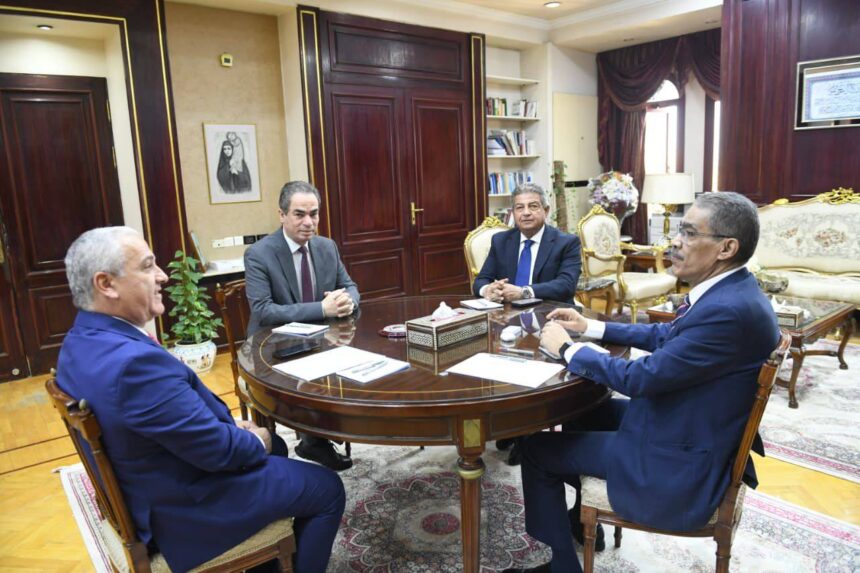
Egypt’s media leadership agreed on Tuesday to a new coordination framework aimed at enhancing national awareness and combating rumours, following directives from President Abdel Fattah al-Sisi to provide a professional discourse for all segments of society.
Minister of State for Information Diaa Rashwan met with Khaled Abdel Aziz, head of the Supreme Council for Media Regulation (SCMR), Abdel Sadiq El-Shorbagy, head of the National Press Authority (NPA), and Ahmed El-Muslimani, head of the National Media Authority (NEA), at the ministry’s headquarters. The participants stated that the presidential mandates constitute a “work programme” to be implemented within their respective jurisdictions.
The meeting followed instructions issued by President al-Sisi to the newly formed government, specifically a directive to “give maximum importance to public opinion and enlighten it constantly with facts through a national media capable of reaching all components of Egyptian society.” The president’s mandate further called for a responsible professional discourse to “form a collective awareness in the face of challenges and rumours” while promoting a culture of constructive dialogue and respect for the opinions of others.
The officials expressed appreciation for Prime Minister Mostafa Madbouly’s focus on the media’s role in consolidating Egyptian identity and highlighting challenges to decision-makers. They referenced the Prime Minister’s meeting with Rashwan on Monday, Feb 16, which emphasised the need for “continuous coordination” between the ministry and media bodies to ensure integration while preserving the constitutional independence of those entities.
According to the statement, this coordination aims to provide a common ground for national discussion and “restore the status of Egyptian media” through messages that respect societal values and traditions without excluding any faction, while adhering to constitutional guarantees for freedom of expression and opinion.
The heads of the SCMR, NPA, and NEA congratulated Rashwan on his appointment as Minister of State for Information, expressing confidence that his political and media experience would help the ministry fulfil its role.
The participants outlined a collaborative framework based on the following constitutional and legal roles:
- Ministry of State for Information:Representing the government to public opinion, explaining policies, correcting misinformation, and coordinating between media entities.
- Supreme Council for Media Regulation (Law 180 of 2018):Receiving notifications for newspaper establishments, granting licences for audio, visual, and digital media, and enforcing professional ethics and standards.
- National Press Authority (Law 179 of 2018):Managing and developing state-owned press institutions, ensuring their independence, neutrality, and efficient economic performance.
- National Media Authority (Law 178 of 2018):Managing public media institutions to provide television, radio, and digital broadcasting and production, as well as related engineering services.
The leadership affirmed their commitment to developing professional performance to keep pace with the state’s comprehensive development plans. The meeting concluded with an agreement to hold regular sessions to strengthen institutional integration across the sector.


