

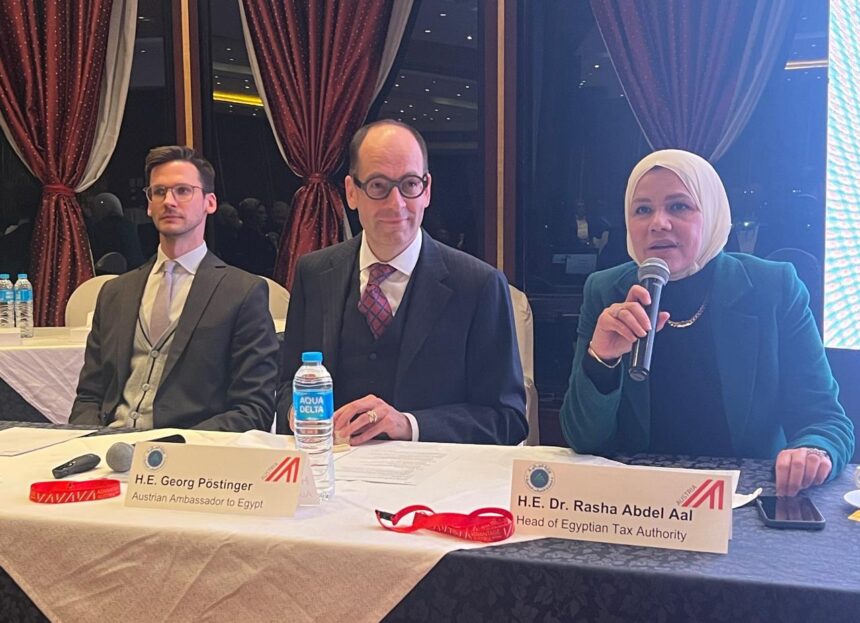
Rasha Abdel Aal, Head of the Egyptian Tax Authority (ETA), said the second package of tax facilitation measures—comprising 26 provisions—places strong emphasis on supporting compliant taxpayers, notably by accelerating value-added tax (VAT) refunds, expanding the number of eligible cases, increasing refundable amounts, and simplifying related procedures.
Speaking at a conference organised with the Austrian Chamber of Commerce and Austrian companies operating in Egypt, Abdel Aal said the Minister of Finance attaches great importance to the role played by civil society institutions and the business community in supporting the national economy.
She explained that the tangible positive outcomes achieved through the first package of tax facilitations—particularly its direct contribution to higher voluntary compliance rates—provided a strong incentive to introduce a second package to build on this success. She added that the new measures were presented for societal dialogue to gather the views of development partners, address the challenges they face, and reinforce the principles of partnership and transparency.
Abdel Aal highlighted additional incentives introduced by the Ministry of Finance for businesses joining the simplified tax regime, including access to financing programmes offered in coordination with the Micro, Small and Medium Enterprise Development Agency (MSMEDA). These incentives complement the benefits stipulated under Law No. 6 of 2025, which applies to projects with annual turnover not exceeding EGP 20m and sets a graduated income tax scale with a maximum rate of 1.5%.
She noted that the law is designed to reassure taxpayers, encourage integration into the formal economy, broaden the tax base, and enhance fiscal sustainability.
In support of digital transformation, Abdel Aal announced the launch of a mobile application for real estate disposal tax, allowing individuals to notify the authority of transactions, pay the 2.5% tax electronically, and obtain tax clearance in a simplified and seamless manner. She also referred to the establishment of an electronic consultation platform that enables the business community to submit feedback on draft laws, decisions, and other ETA issuances before their release.
She pointed to recent developments in the central clearing system, which now facilitate electronic offsetting between taxpayers’ credit and debit balances. Abdel Aal also announced the issuance of a comprehensive guideline on the tax treatment of exported services in line with international standards, alongside the start of work to establish mechanisms separating commercial audits from transfer pricing audits. A new stage has also been introduced to review taxpayers’ appeals against the outcomes of transfer pricing examinations.
The ETA head further announced the launch of premium tax service centres, designed to deliver a modern and efficient tax experience by streamlining procedures, reducing congestion, and eliminating long waiting times. She said the initiative aims to present the Tax Authority as a supportive partner to economic activity.
According to Abdel Aal, the centres will provide a fully integrated range of services under one roof, including tax registration, awareness of tax facilitation measures, investor support, and technical assistance for digital systems such as e-invoicing and e-receipts, effectively applying the one-stop-shop model.
She added that the second package also targets support for several key sectors. In tourism, departure fees will be unified in response to sector demands. In industry, the development fee on cement will be unified across all types—white and black—marking a significant shift in the approach to managing sector-related fees.
Abdel Aal stressed that the Egyptian Tax Authority will continue to receive and promptly address issues raised by the tax community. She noted that during the conference, ETA officials responded to all technical inquiries from participants, including representatives of Austrian investors in Egypt, reinforcing mutual trust between the Ministry of Finance, the Tax Authority, and the investment community.

