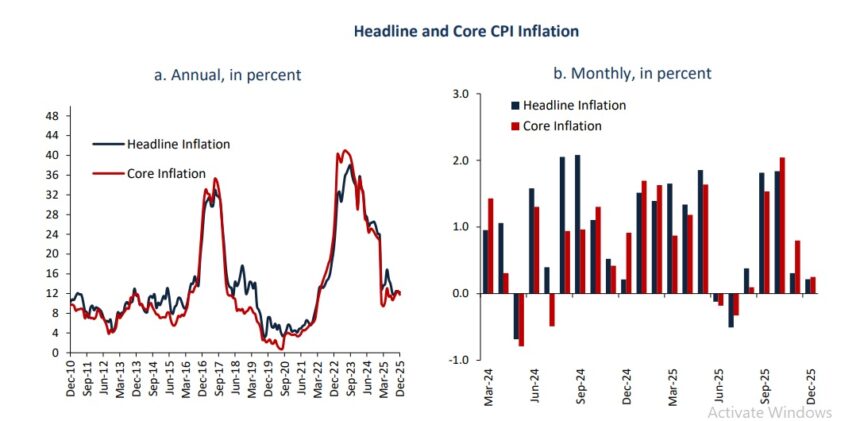
Annual urban headline inflation remained stable at around 12.3% in December 2025, virtually unchanged from November, according to the Central Bank of Egypt (CBE). The annual dynamics of headline inflation continue to be driven primarily by non-food prices, as food inflation has fallen back to its pre-2022 levels.
Annual food inflation declined sharply to 1.5% in December 2025, down from 20.3% in December 2024, although it rose slightly from 0.7% in November 2025. The impact of this increase was limited, as annual non-food inflation eased to 19.5% in December 2025 from 20.2% in November and 26.7% a year earlier.
Annual core inflation declined to 11.8% in December 2025 from 12.5% in November, driven by weaker contributions from core food, retail and services. Monthly core inflation also decelerated to 0.2% in December, compared with 0.8% in November and 0.9% in December 2024, reflecting mainly negative core food inflation.
Monthly urban headline inflation stood at 0.2% in December 2025, broadly unchanged from 0.3% in November and matching the rate recorded in December 2024. This stability reflects broad-based price declines in volatile and core food items, which partially offset increases in services and regulated prices following higher household natural gas tariffs.
At the regional level, annual rural headline inflation rose to 8.3% in December 2025 from 7.9% in November. Meanwhile, annual nationwide headline inflation edged up slightly to 10.3% from 10.0% in the previous month.
Monthly food inflation registered negative 0.7% in December 2025, contributing a negative 0.26 percentage point to monthly headline inflation.
Food inflation drivers
The decline in food inflation during December was driven by several factors. Volatile food prices fell by 1.6%, contributing negative 0.09% to monthly headline inflation, broadly in line with seasonal patterns, albeit more pronounced. Prices of fresh fruits and vegetables declined by 2.3% and 1.0%, respectively.
Poultry prices fell for the third consecutive month, declining by 2.5% and contributing negative 0.11% to monthly headline inflation. Egg prices also dropped by 5.7%, contributing negative 0.09%.
Non-food inflation drivers
Monthly non-food inflation reached 0.8% in December, contributing 0.48% to monthly headline inflation.
Regulated prices rose by 0.6%, contributing 0.12%, mainly due to a 23.0% increase in household natural gas prices—the second hike in 2025—which alone contributed 0.11%. Additional upward pressures stemmed from a modest 0.2% increase in tobacco prices.
Prices of services increased by 0.9%, contributing 0.27% to monthly headline inflation, driven primarily by higher rents and increased spending at restaurants and cafés. Retail prices rose by 0.6%, contributing 0.08%, reflecting increases in clothing and footwear, household cleaning products and personal care items.
Monthly core inflation stood at 0.2% in December 2025, reflecting the combined impact of these developments. Core food contributed negative 0.24% to monthly core inflation, while services and retail items contributed 0.37% and 0.12%, respectively.