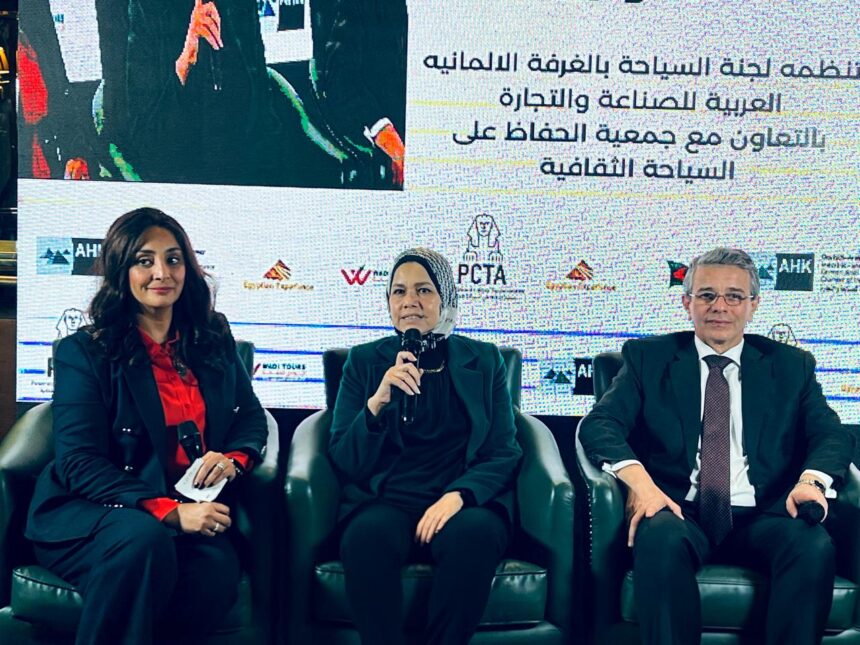
Rasha Abdel Aal, Head of the Egyptian Tax Authority, said the Ministry of Finance and the Authority are giving special attention to the tourism sector, describing it as a vital contributor to national income that receives targeted support to help resolve its challenges.
Speaking at the Tourism Salon seminar organised by the Tourism Committee of the German Arab Chamber of Industry and Commerce, in cooperation with the Association for the Preservation of Cultural Tourism, Abdel Aal said several specialised committees have been formed to address sector-specific issues. These include a high-level committee bringing together the Ministry of Finance and the Egyptian Tourism Federation, as well as a subcommittee chaired by the Head of the Tax Authority.
She explained that while the Authority applies the law in cases of tax evasion, these committees have helped resolve numerous disputes and restructure outstanding dues for financially distressed companies through flexible mechanisms that strike a balance between safeguarding public revenues and ensuring business continuity.
Abdel Aal noted that services provided within the exhibition halls of the Grand Egyptian Museum have been classified as museum services exempt from value-added tax, reflecting the Ministry of Finance’s recognition of tourism’s role in boosting national income and advancing sustainable development goals.
She added that from the first hours of Ahmed Kouchouk’s tenure as Minister of Finance, priority was given to addressing the most pressing tax challenges facing the business community. This approach, she said, aimed to resolve obstacles while ensuring tax justice, protecting taxpayers and supporting the continuity of economic activity, leading to the launch of the first package of tax facilitation measures.
According to Abdel Aal, relations between the Egyptian Tax Authority and taxpayers have seen tangible improvement over the past year and a half.
“Since 2018, we have embarked on a successful journey—acknowledged by the business community, investors and international institutions—towards digital transformation,” she said, noting that the size of the informal economy remains one of the main challenges hindering the achievement of full tax justice.
She stressed the importance of prioritising challenges according to urgency, an approach reflected in the first package of tax facilitation measures launched in February. The package included key incentives, most notably allowing the submission or amendment of tax returns for the period from 2020 to 2024 without penalties.
Abdel Aal said these measures have strengthened voluntary compliance and prompted a positive response from taxpayers during the most recent filing season, with many submitting returns early and settling obligations voluntarily, helping to build trust and partnership between the Authority and the business community.
She added that this positive feedback encouraged the Ministry of Finance and the Tax Authority to expand incentives through a second package of facilitation measures, the provisions of which were opened to community dialogue throughout December ahead of its official launch.
Abdel Aal also said a comprehensive guidance manual has been issued to clarify the tax treatment of exported services under the Value-Added Tax Law and its executive regulations. The guide explains the concept of exported services, rules for determining the place of taxation, required documentation, and practical examples of applying the zero-rated tax treatment, including services provided remotely from Egypt to clients abroad.
For his part, Ahmed Amwi, Head of the Egyptian Customs Authority, said the tourism sector is a cornerstone of national income, noting that customs interacts with the sector through exemptions on certain supplies used by hotels and tourism establishments, including tourist vehicles and buses.
Amwi said that since 2019, the Customs Authority has implemented a series of reforms aimed at simplifying and digitising procedures, reducing burdens on investors, avoiding storage penalties, and accelerating import and export processes. These measures, he added, have had a positive impact on the import of supplies for tourism facilities.
He stressed the importance of dialogue-based meetings in identifying challenges, reviewing implemented reforms and reaching unified procedures and legislation that balance investor interests with state requirements while supporting the tourism sector.