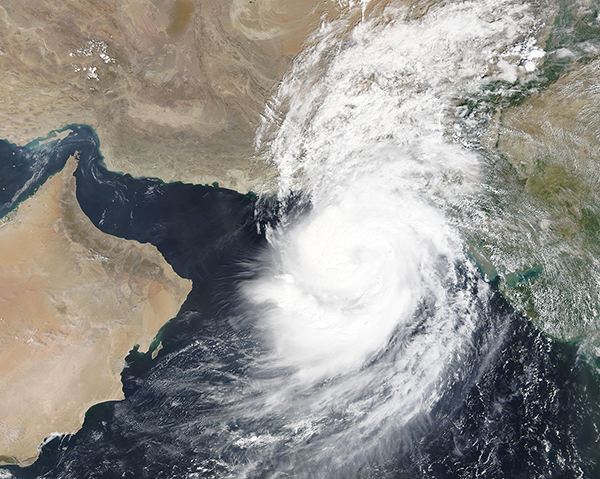
When Cyclone Shaheen struck northern Oman in October 2021, the sea was not the only factor shaping the storm’s behaviour. The mountains rising behind the coast were also part of the equation, but in a different way. While warmer waters can provide a cyclone with more energy and moisture, the terrain can alter its track and redistribute rainfall between coastal areas and higher elevations.
This picture emerges from a new study that used Cyclone Shaheen as a case study to examine what happens when the environmental conditions surrounding a tropical cyclone approaching Oman are altered. The researchers found that increasing sea surface temperatures in simulations intensified the cyclone and increased rainfall, while changes in terrain elevation had a greater effect on its track, internal air circulation, and the areas receiving precipitation.
The study, recently published in Scientific Reports, was conducted by a team of researchers from Sultan Qaboos University, Oman’s Directorate General of Meteorology, and the German Weather Service. The team used an advanced numerical weather prediction model to recreate Cyclone Shaheen at a spatial resolution of 6.5 kilometres.
Badria Al Maawali, a researcher in the Department of Physics at Sultan Qaboos University and Oman’s Directorate General of Meteorology, and the study’s lead author, said the team’s main conclusion is that simulations of a tropical cyclone approaching Oman can be strongly influenced by both ocean conditions and the region’s complex terrain, although each factor operates through different mechanisms.
To determine the scale of these effects, the researchers virtually reran the cyclone in a series of experiments, changing some of the surrounding conditions each time, including sea surface temperature, terrain elevation, and sea surface roughness. They then examined how these changes affected the storm’s intensity, track, rainfall, and internal structure.
According to Al Maawali, the strongest response occurred when the team increased sea surface temperatures by 2°C. In this experiment, the warmer water supplied the cyclone with more energy and moisture, supporting greater cloud and storm activity within the system and increasing its intensity. She explained that the simulated mean wind speed rose by about 2.1 metres per second compared with the control experiment, while mean sea-level pressure fell by around 3.2 hectopascals — both indicators of a stronger cyclone.
The effect was not limited to wind intensity. The area receiving substantial rainfall also expanded, and precipitation increased across the main region affected by the cyclone. For coastal communities in Oman, Al Maawali said, the important finding is that both cyclone intensity and the amount of rainfall it produces can be sensitive to the ocean conditions encountered by the storm before landfall.
But when the researchers shifted their attention from sea to land, the picture changed. Reducing terrain elevation in the model primarily altered the cyclone’s track and reduced rainfall enhanced by the mountains. It also reorganised the storm’s vertical air circulation, from the movement of air and moisture near the surface to rising air and its outward spread in the upper atmosphere.
This finding is particularly important for Oman, where mountain ranges rise close to parts of the coastline. When moisture-laden air encounters these highlands, it is forced upward, encouraging water vapour to condense and producing heavier rainfall. The mountains therefore do more than shape the landscape over which a cyclone travels; they can also help determine which areas receive its heaviest rain.
By contrast, the realistic changes in sea surface roughness tested by the researchers had a smaller effect on cyclone intensity and rainfall distribution than either water temperature or terrain, according to Al Maawali.
She added that the findings highlight the importance of accurately representing both the ocean and the terrain in cyclone models used for Oman. Sea surface temperature had a greater influence on cyclone intensity and rainfall amounts, while topography played a larger role in determining the storm’s track, vertical circulation, and the geographical distribution of rainfall.
Although the experiment that increased sea surface temperature by 2°C may appear directly linked to climate change, Al Maawali cautioned against interpreting the results in that way. The researchers uniformly increased sea surface temperatures while keeping the broader atmospheric conditions associated with Cyclone Shaheen unchanged. The purpose was to isolate the effect of a warmer ocean and examine how the model responded, rather than to predict what will happen in the coming decades.
She explained that climate change does not alter sea temperatures alone. It can also affect atmospheric circulation, humidity, winds, ocean structure, and other factors that influence tropical cyclones. The study therefore cannot determine whether future Arabian Sea cyclones will become more frequent or more intense, nor should the numerical results from the Shaheen experiment be treated as quantitative forecasts of future conditions.
The study has other limitations. Most importantly, it examined only a single cyclone and focused on three specific factors. The simulations were also conducted at a resolution of 6.5 kilometres, at which some processes involved in cloud formation and rainfall still have to be represented approximately by the computer model.
Al Maawali said the next step should be to test additional cyclones, use higher-resolution models, improve the representation of interactions between the ocean and atmosphere, and compare the results with more field observations from the region. If the same patterns are confirmed in other storms, they could help improve cyclone forecasting and assessments of flood risk.