

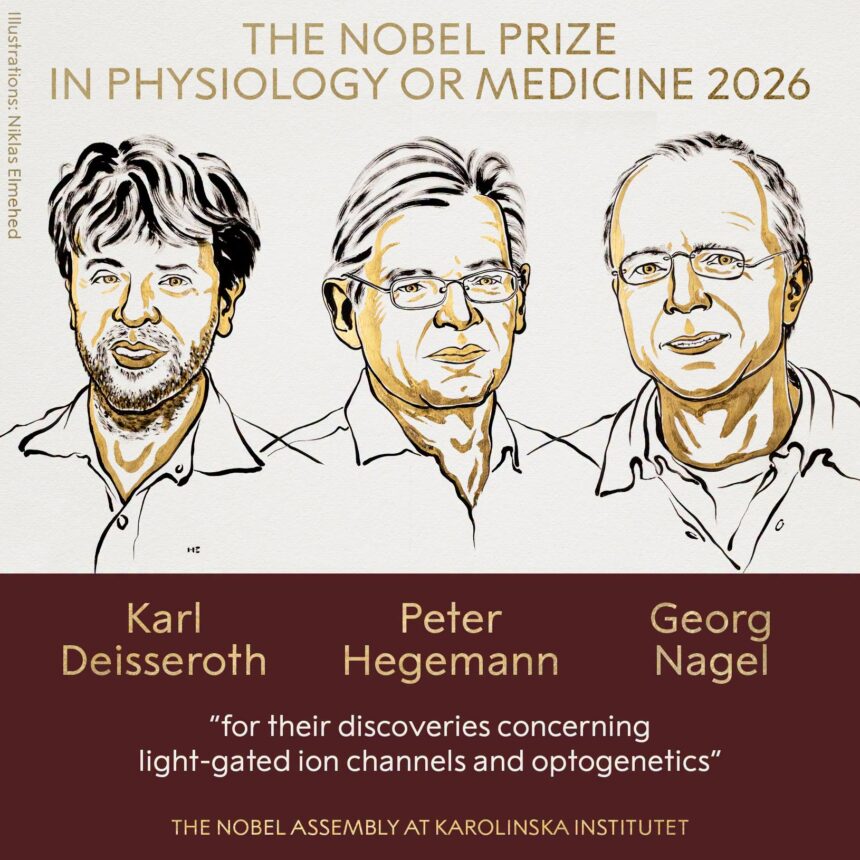
Scientists Karl Deisseroth, Peter Hegemann, and Georg Nagel won the 2026 Nobel Prize in Physiology or Medicine on Monday for discoveries that led to optogenetics, a technique that allows researchers to control nerve cells using light.
The Nobel Assembly at Sweden’s Karolinska Institutet said the three laureates were honoured for discoveries involving light-gated ion channels and optogenetics, which has become a powerful tool for investigating how neural circuits shape memories, emotions, and behaviour.
The work began with research by Hegemann and Nagel on Chlamydomonas, a single-celled alga capable of swimming towards light.
In the early 2000s, the two scientists identified channelrhodopsin, a light-sensitive protein that forms a channel in the cell membrane. When exposed to blue light, the channel opens, allowing charged ions to flow into the cell and generate an electrical impulse.
They also showed that transferring the protein into other types of cells could make those cells sensitive to light.
Deisseroth then introduced the gene for channelrhodopsin into rat nerve cells and demonstrated that blue light could be used to trigger a neural signal.
He published the breakthrough in 2005 and, two years later, demonstrated that the light-controlled system could also work in the brains of living mice, paving the way for what became known as optogenetics.
The Nobel Assembly said the technique transformed neuroscience by allowing researchers to move beyond simply associating parts of the brain with particular functions and instead test how activating specific groups of nerve cells can cause changes in behaviour or bodily functions.
Researchers have since used optogenetics to identify neural circuits involved in specific memories, emotions, and behaviours, including processes relevant to neurological and psychiatric disorders.
The approach is also being explored in clinical research, including attempts to restore sight in people with visual impairment, the Nobel Assembly said.
Per Svenningsson, Chair of the Nobel Committee for Physiology or Medicine, said optogenetics had opened possibilities for mapping the brain that researchers could previously only imagine.
Deisseroth, born in 1971, is affiliated with the Howard Hughes Medical Institute and Stanford University in the United States. Hegemann, born in 1954, is a professor of neuroscience at Humboldt University of Berlin, while Nagel, born in 1953, is a professor at the University of Würzburg in Germany.
The prize carries an award of SEK 12m, to be shared equally among the three scientists.