

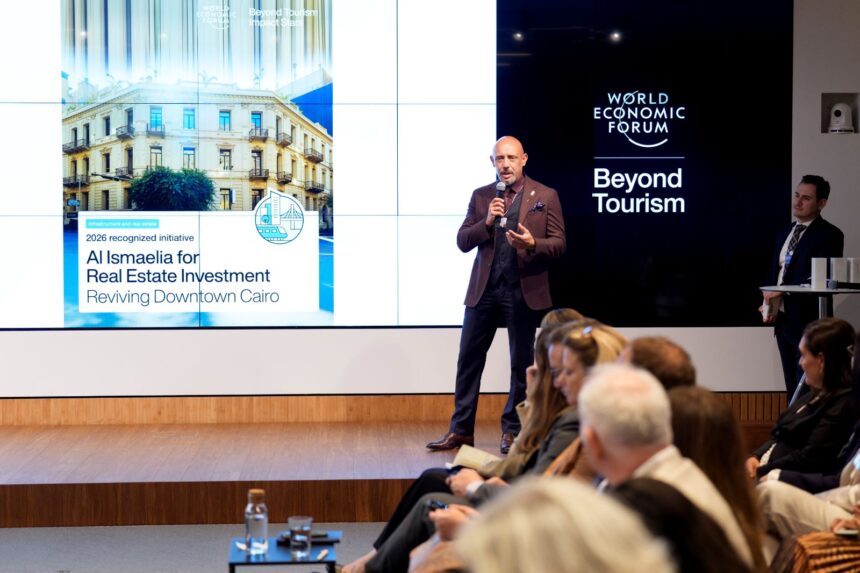
Egyptian real estate developer Al Ismaelia for Real Estate Investment has become the first company in the Middle East and North Africa (MENA) to receive the World Economic Forum’s Beyond Tourism Impact Stars recognition in the Infrastructure and Real Estate category for its “Reviving Downtown Cairo” initiative.
The project, which restores historic buildings for adaptive reuse, was selected among six global winners in the programme’s inaugural cohort. Karim Shafei accepted the recognition on behalf of the company during the Forum’s Beyond Tourism Day in Geneva, Switzerland, on September 25.
Developed by the World Economic Forum in partnership with Saudi Arabia’s Ministry of Tourism and in collaboration with Kearney, the Beyond Tourism Impact Stars programme recognises commercially viable, private-sector initiatives that address travel challenges and deliver measurable benefits for businesses, destinations, and communities.
“Downtown’s architecture is an extraordinary asset, and its future depends on people continuing to use it. Every business that opens, every person who chooses to work here and every visitor who comes back helps sustain the buildings we restore,” Shafei said. “We want visitors to make room for another day in Cairo to walk through Downtown, discover Egyptian designers, enjoy a meal and experience the culture within these buildings. That extra day creates opportunities for the businesses and people who make the neighborhood what it is. Being the first company in the region recognized in this category puts Downtown Cairo forward as an example of how urban heritage can support tourism and local businesses. This recognition gives international visibility to an approach we have been developing since 2008. We are actively making heritage a productive part of the city’s life, with commercial uses that fund its upkeep and cultural activity that gives people reasons to return.”
Established in 2008, Al Ismaelia has acquired and restored a network of 25 properties across Downtown Cairo, adapting them for contemporary uses whilst preserving their architectural character. The portfolio includes Cinema Radio, which combines cultural events with offices, shops, and food and beverage venues; the La Viennoise Building, housing a boutique hotel, a rooftop venue, and spaces for local brands; the Nabarawy Fashion Hub for independent Egyptian fashion brands; and Tamara Haus, which integrates hospitality, dining, design, shops, and cultural activity.
Cultural programming and the selection of businesses are central to the properties’ operations, generating commercial activity that supports the ongoing maintenance required by historic buildings. By creating spaces for hospitality, businesses, independent Egyptian brands, and cultural events, the company aims to encourage tourists to add an extra day to their Cairo itineraries to explore the area’s architecture and local venues.
For Egypt, the recognition aligns with national objectives to diversify the tourism product, develop destinations, maximise economic returns, and attract private investment beyond traditional tourism circuits. The initiative demonstrates how heritage-led urban regeneration and adaptive reuse can turn historic assets into platforms for economic growth, entrepreneurship, and employment, whilst retaining local identity and supporting quality of life. The company’s experience provides a practical model for other Egyptian cities to link destination development with heritage conservation, demonstrating how heritage can be activated as a productive asset rather than preserved in isolation.
Operating alongside public institutions, local businesses, and cultural organisations, Al Ismaelia contributes to the wider revival of Downtown Cairo. As a member of the inaugural cohort, the company will participate in a year-long programme with the World Economic Forum to share lessons, exchange knowledge, and explore opportunities for the wider adoption of successful approaches across other historic urban districts in the region.

