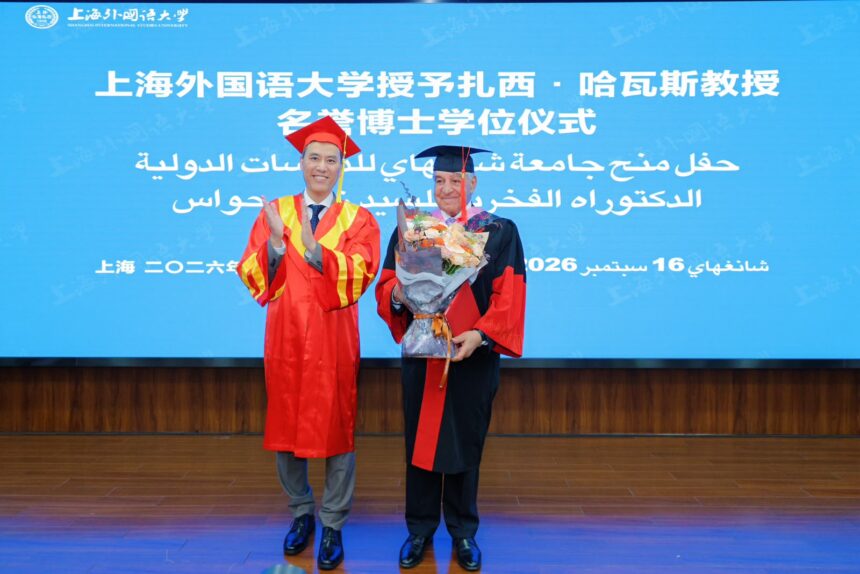
Egyptian archaeologist Zahi Hawass has received an honorary doctorate from Shanghai International Studies University in China, becoming only the second international figure in the university’s nearly 75-year history to receive the prestigious degree, after Turkish President Recep Tayyip Erdoğan.
The honorary doctorate comes as Egypt and China celebrate 70 years of diplomatic relations, following Chinese President Xi Jinping’s official visit to Egypt and his meeting with President Abdel Fattah El-Sisi.
The awarding of honorary doctorates in China is subject to strict academic standards, with only 10 honorary degrees granted annually across more than 300 Chinese universities.
Hawass’s nomination went through several stages, including securing explicit international approval and consensus. Four leading Egyptologists and specialists from four different countries submitted academic reports supporting his nomination, followed by approval from the Shanghai University Council and official endorsement by China’s Ministry of Education.
The university’s main hall was filled with professors, deans and students for the ceremony. The university’s president welcomed Hawass in his honorary academic robes amid a large reception and applause.
In his speech, the university president said the honorary doctorate recognised Hawass’s international standing as an archaeologist and his contributions through books, research and academic studies. He also expressed the university’s pride in adding Hawass’s name to its honorary records.
Hawass expressed his happiness at receiving the honour, noting that it is his 13th honorary doctorate from 13 different countries. He said the degree holds particular significance for him because of its rarity and the strict academic traditions governing its award.
On the sidelines of the ceremony, Hawass donated five academic publications from his work to the Shanghai University library, including two books focusing on his discoveries and the activities of Egyptian archaeological missions in the Valley of the Kings.
The event concluded with a one-hour academic lecture by Hawass, during which he discussed recent archaeological discoveries in the Valley of the Kings and addressed historical theories and questions.
The lecture was followed by an open discussion with Chinese students and academics, who presented him with flowers and commemorative shields. The university president later hosted an official dinner in his honour, attended by leaders from educational and cultural institutions.