

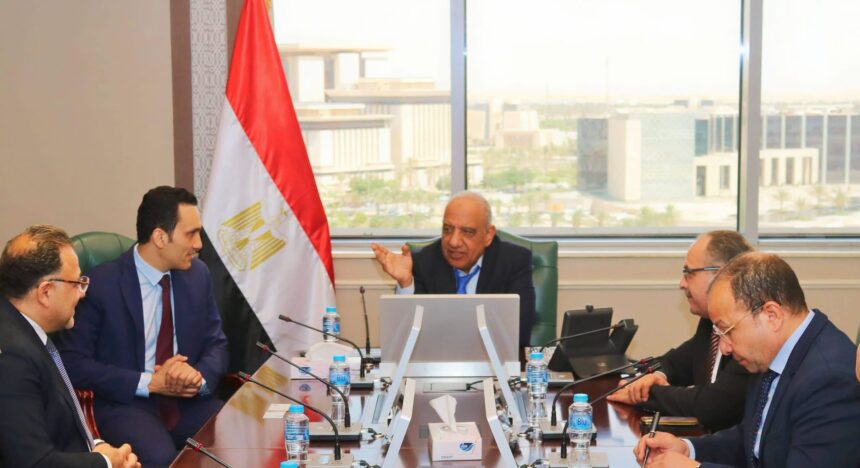
Egyptian Minister of Electricity and Renewable Energy Mahmoud Esmat held talks with the head of Belgian firm Hydrovolta, George Brek, to discuss cooperation on a proposed project to desalinate 10 million cubic metres of water daily by 2050 using existing power plant infrastructure.
The meeting at the ministry headquarters in the New Administrative Capital was attended by Arab Contractors Chairman Ahmed El-Assar and Scatec Norway Chief Executive Mohamed Amer. Discussions focused on electrochemical treatment systems for saline groundwater, seawater desalination, and extracting commercial compounds and minerals from desalination residue.
During the meeting, Esmat reviewed Hydrovolta’s SonixED technology, which combines electrodialysis to remove ions and pollutants with ultrasound to limit salt precipitation. The process is designed to improve water treatment efficiency while reducing scaling issues, chemical requirements, and energy consumption.
The technology enables the treatment of highly saline groundwater for drinking or irrigation while extracting by-products such as magnesium hydroxide, calcium carbonate, sodium chloride, potassium chloride, bromine, and hydrochloric acid.
The proposed desalination project’s first phase targets a capacity of 3.35 million cubic metres daily, focusing on chemical production to reduce national imports. A second phase would introduce a system to extract, purify, dry, and classify magnesium, converting it into an economic product.
Officials highlighted the correlation between lowering the cost of desalinated water produced at power plants and the integration of renewable energy sources, particularly solar and wind power, to reduce long-term operational costs. The meeting addressed seawater desalination as a crucial opportunity to support development plans in coastal areas and expand urban, industrial, and tourism projects under the state’s sustainable development strategy.
Esmat stated that desalination projects represent a promising field for attracting foreign and private investments, localising technology, and establishing related industries, including equipment manufacturing and technical expertise transfer.
The minister affirmed that the electricity sector operates through an integrated strategy targeting operational quality and the efficient management of available resources in partnership with the private sector. He added that the state provides all possible support to encourage private sector participation and partnerships to localise modern technology and maximise economic returns.


