Male humpback whales are renowned for their haunting songs, which can last for hours and travel vast distances through the ocean during the breeding season. While scientists have studied these vocal displays for decades, far less has been known about what whales are doing underwater as they sing.
A new study published in Current Biology has found that humpback whale songs are closely synchronised with the animals’ diving behaviour, revealing a hidden pattern that could reshape scientists’ understanding of whale communication while supporting future conservation efforts.
The research was led by Julia Zeh, a recent PhD graduate at Syracuse University.
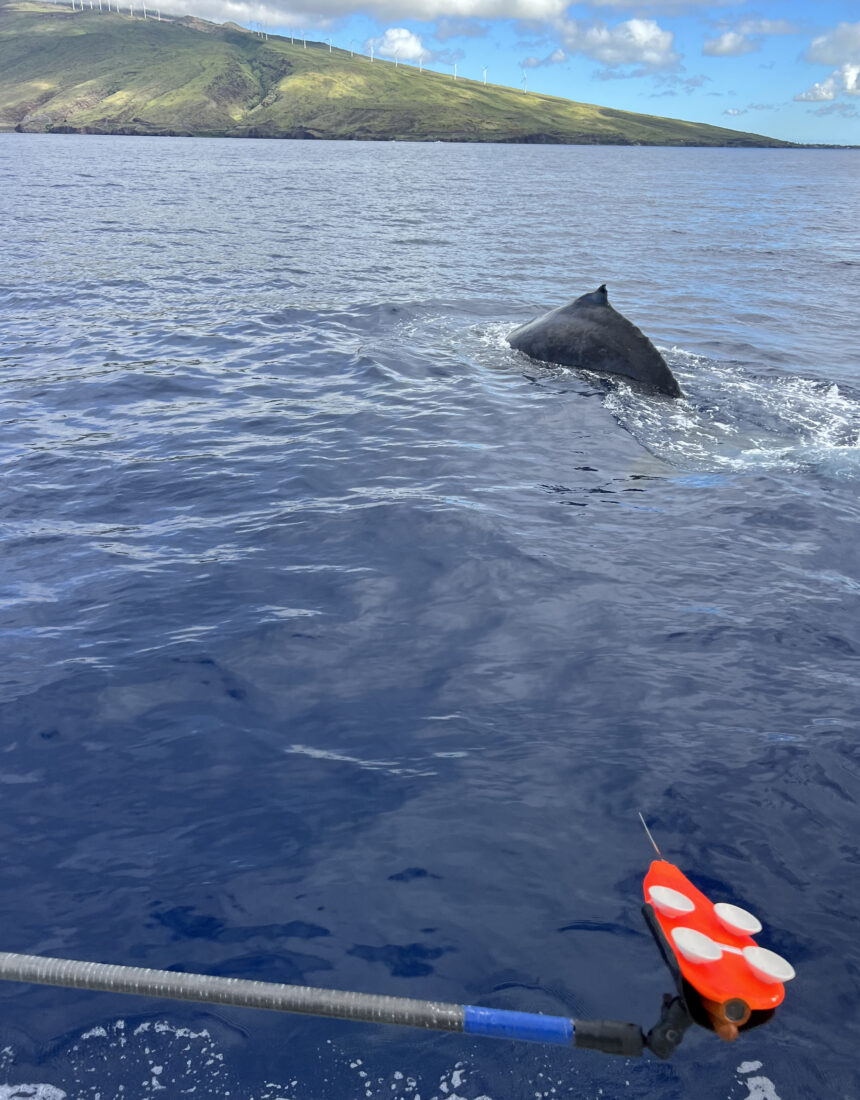
To investigate the relationship between singing and movement, researchers attached suction-cup recording tags to 16 male humpback whales off the coast of Maui, Hawaii.
The non-invasive devices simultaneously recorded the whales’ songs and their underwater movements. After several hours, the tags detached naturally, floated to the surface, and were retrieved by the research team.
Fieldwork was conducted between 2018 and 2024, during which researchers observed some whales singing continuously for up to 16 hours.
The study’s most significant finding was that different sections of the whales’ songs consistently corresponded to different phases of each dive.
Humpback whale songs consist of repeated sequences known as “themes.” Rather than being performed randomly, the researchers found that specific themes consistently occurred while whales were descending, others during the deepest part of the dive, and others again as they ascended toward the surface.
Although previous research had suggested that certain song sections were associated with near-surface behaviour, this is the first study to demonstrate that the overall structure of humpback whale songs mirrors the complete dive cycle.
The researchers believe the findings could also shed light on how whale songs evolve.
Song themes performed during the deepest and most stable phase of a dive showed greater variation among individual whales than those sung during ascent or descent.
According to the researchers, this pattern suggests that these portions of the song may be influenced by sexual selection, helping females assess potential mates or allowing males to distinguish themselves from competitors.
By contrast, song sections produced while whales were changing depth appear to be more constrained by the physical demands of diving, including maintaining buoyancy and managing oxygen reserves.
“This gives us direction for which parts of the song to investigate if we’re interested in variation,” Zeh said.
The findings could also have practical applications for whale conservation.
Scientists already use underwater acoustic monitoring to track whale populations. By understanding how specific song patterns correspond to underwater movements, researchers may eventually be able to estimate a whale’s depth or position simply by analysing its song.
Such advances could make it easier to detect behavioural changes caused by human activities, including ship traffic, underwater construction, and noise pollution.
Establishing what constitutes normal singing behaviour is considered an important step towards identifying when whales are being disturbed by their environment.
The study focused on humpback whales breeding around Hawaii, and the researchers caution that it remains unclear whether whales in other populations exhibit the same relationship between singing and diving.
Humpback whale populations are known to develop distinct regional songs, raising the possibility that the connection between vocal behaviour and diving may also vary across different ocean basins.
Answering that question will require comparable studies at breeding grounds around the world.
The researchers say their work opens a new avenue for studying animal communication by examining vocalisations alongside movement, physiology, and behaviour rather than analysing sounds in isolation.
The approach could eventually be applied to many other sound-producing species, offering new insights into how complex communication systems have evolved in the natural world.
For humpback whales, the findings suggest that every dive follows a carefully coordinated sequence in which movement and music are intimately linked, revealing that their songs are not merely beautiful vocal displays but an integral part of life beneath the ocean’s surface.